
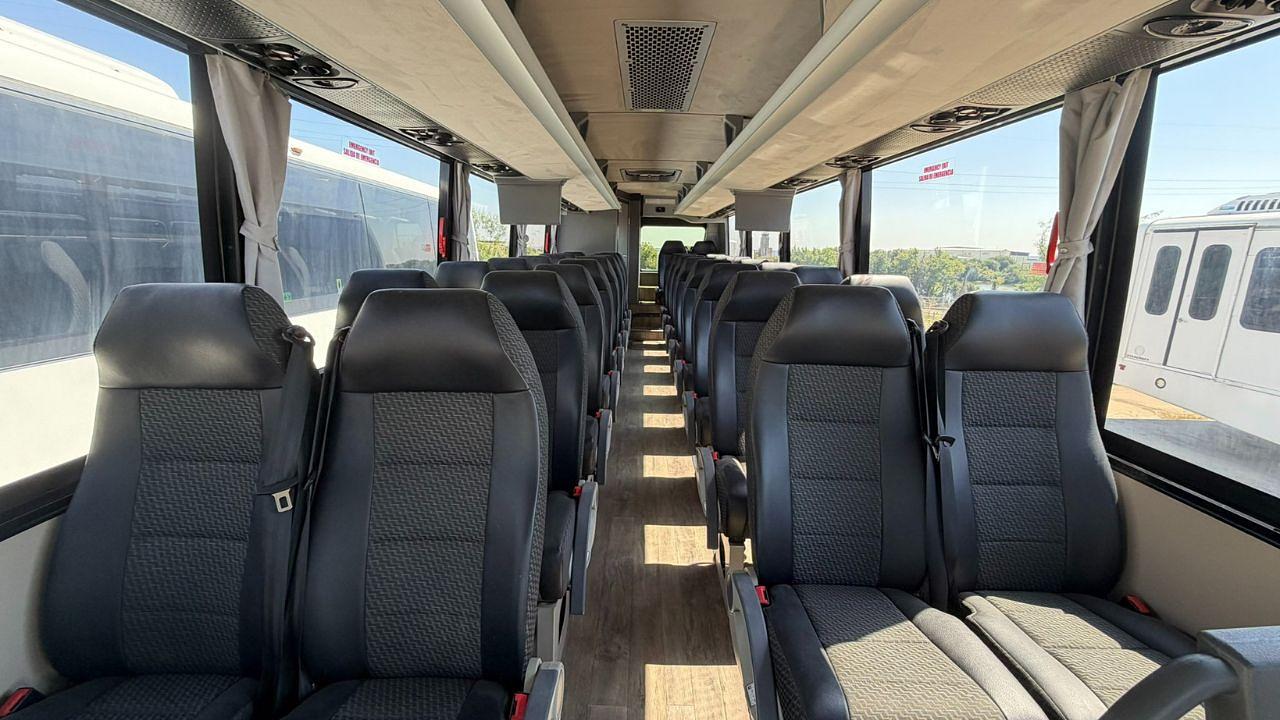
Coach bus seating capacity ranges from 10 passengers in a party bus to 80 or more in a double-decker. The standard US full-size motorcoach seats 55 to 56 passengers. That number matters more than any other in this guide and we’ll explain why shortly.
Whether you’re planning a group trip and need to know how many seats you’re paying for, or you’re an operator figuring out what capacity makes sense for a new fleet vehicle, the answer is different depending on which question you’re actually asking. This guide covers both.
For group travel planners: the seat count tells you what you’re booking and what it’ll cost per person. For fleet operators: the seat count tells you what jobs you can take, what the vehicle is worth at resale, and whether the configuration earns its keep. The Bus Coach sells and sources motorcoaches across the full capacity spectrum and we’ve built this guide to be the reference both audiences actually need.
Quick Reference: Coach Bus Seating Capacity by Type
Here’s every main bus type with seating capacity in one place. The ‘Best Use’ column is the honest version, not the marketing version.
Bus Type: Minibus / cutaway
Seating Capacity: 15 to 30
Body Length: 20 to 30 ft
Best Use: Airport loop, hotel shuttle, small groups
Bus Type: Mini coach
Seating Capacity: 24 to 35
Body Length: 28 to 32 ft
Best Use: Corporate shuttle, campus, airport contract
Bus Type: Activity school bus
Seating Capacity: 48 to 72
Body Length: 35 to 40 ft
Best Use: Budget line-haul, ski trips, athletics
Bus Type: Full-size motorcoach
Seating Capacity: 55 to 56
Body Length: 40 to 45 ft
Best Use: General charter, tours, line-run (US standard)
Bus Type: Luxury / VIP coach
Seating Capacity: 20 to 40
Body Length: 40 to 45 ft
Best Use: Premium corporate, upscale charter
Bus Type: Double-decker
Seating Capacity: 60 to 80
Body Length: 40 to 45 ft
Best Use: High-volume sightseeing, urban routes
Bus Type: Party bus
Seating Capacity: 10 to 30
Body Length: 25 to 40 ft
Best Use: Events, celebrations, nightlife
Bus Type: Sleeper coach
Seating Capacity: Berths vary
Body Length: 45 to 60 ft
Best Use: Multi-night travel, touring crews, bands
Two types are missing from most competitor guides and both are worth knowing. Party buses sit at the smaller end of the capacity spectrum with 10 to 30 passengers, but the interior configuration bears no resemblance to a standard motorcoach. They’re built around events and celebrations rather than point-to-point transit, with lounge seating, entertainment systems, and occasionally bars. Sleeper coaches are the other specialty category, used by touring musicians, sports teams, and production crews on multi-night runs. Their ‘capacity’ is measured in berths rather than seats and a 45-foot sleeper typically carries 10 to 14 berths where a standard coach of the same length carries 55 passengers.
Why 55 to 56 Seats Is the US Standard Bus Seating Capacity
The 55 to 56-passenger configuration is the US motorcoach standard and it’s not arbitrary. It’s the capacity that fits the widest range of charter, tour, and line-run jobs in one vehicle. A 56-seat coach can take a full school group, a corporate event, a sports team, a tour group, and a wedding party. It can cover for a competitor who’s sold out on a peak weekend. And when you’re ready to sell it, the resale audience for a standard 56-passenger coach is considerably larger than for any non-standard configuration.
This is the advice experienced operators consistently give to operators building their first fleet: standardise on 55 to 56-passenger full-size coaches before adding anything else. The flexibility to say yes to virtually any group charter, combined with the cleaner resale picture, makes this configuration the backbone of a sustainable fleet. Once you’re established and have specific contracts that call for a different capacity, add niche vehicles on top.
One important correction that circulates in content written for general audiences rather than operators: the standard US motorcoach does not seat ‘45 to 56 passengers.’ That range conflates multiple vehicle categories. The standard bus seating capacity for a full-size US motorcoach with a rear restroom is 55 to 56. Without a restroom, the count reaches 57 to 59 on some models. The restroom is the main variable, not the coach size.
Federal motor carrier safety regulations cap seating at 56 passengers for most intercity coach configurations in the US. On private charter and non-DOT-regulated services, configurations can go higher, but 55 to 56 is what most operators run, what most clients expect, and what most driver and safety training assumes.
How Amenities Reduce Your Actual Coach Bus Seating Capacity
The seat count on a spec sheet is almost never the seat count you end up operating with. Every amenity that goes into a coach takes space that used to hold a seat. Some reductions are mandatory. Some are deliberate choices. All of them affect your revenue capacity per trip, and it’s worth knowing the real numbers rather than the spec sheet numbers.
One figure worth clarifying: a standard rear restroom module in a full-size motorcoach physically occupies the space of 2 to 4 seats in the rear section, not just 1 to 2. The spec sheet maximum might show 58 or 59 seats, and the restroom module brings that down to 55 or 56. That’s the 2 to 4 seat reduction. The difference between a spec sheet of 57 passengers and an actual booking capacity of 55 is almost always the restroom.
Amenity: Standard rear restroom module
Seats Reduced: 2 to 4 seats
Spec Sheet vs Real Count: Real reduction; module occupies rear bay
Notes: Nearly all US charter coaches include this
Amenity: Wheelchair lift + ADA space
Seats Reduced: 2 to 4 seats
Spec Sheet vs Real Count: Depends on lift location
Notes: Required for ADA-accessible configurations
Amenity: On-board galley / kitchen
Seats Reduced: 2 to 4 seats
Spec Sheet vs Real Count: Front or mid-coach installation
Notes: VIP and premium charter configs
Amenity: Legroom upgrade (increased pitch)
Seats Reduced: 6 to 10 seats
Spec Sheet vs Real Count: Drops 56-pass to 46 to 50
Notes: Justifies premium rate on right accounts
Amenity: Premium recliner / wider seats
Seats Reduced: 4 to 8 seats
Spec Sheet vs Real Count: Fewer rows at wider seat width
Notes: Luxury configuration
Amenity: Entertainment bulkhead screen
Seats Reduced: 1 to 2 seats
Spec Sheet vs Real Count: Front of coach installation
Notes: Common on sports team charters
The legroom upgrade row is an interesting one for operators considering a premium strategy. Dropping a 56-passenger coach to 46 or 50 seats by increasing seat pitch removes capacity but may allow a higher rate per seat that more than compensates. Corporate accounts and premium tour operators who are selling comfort as a differentiator can support this. General group charter where clients compare price per head will not. The math needs to work before the configuration is set, not after.
Seating Capacity by Specific US Coach Model
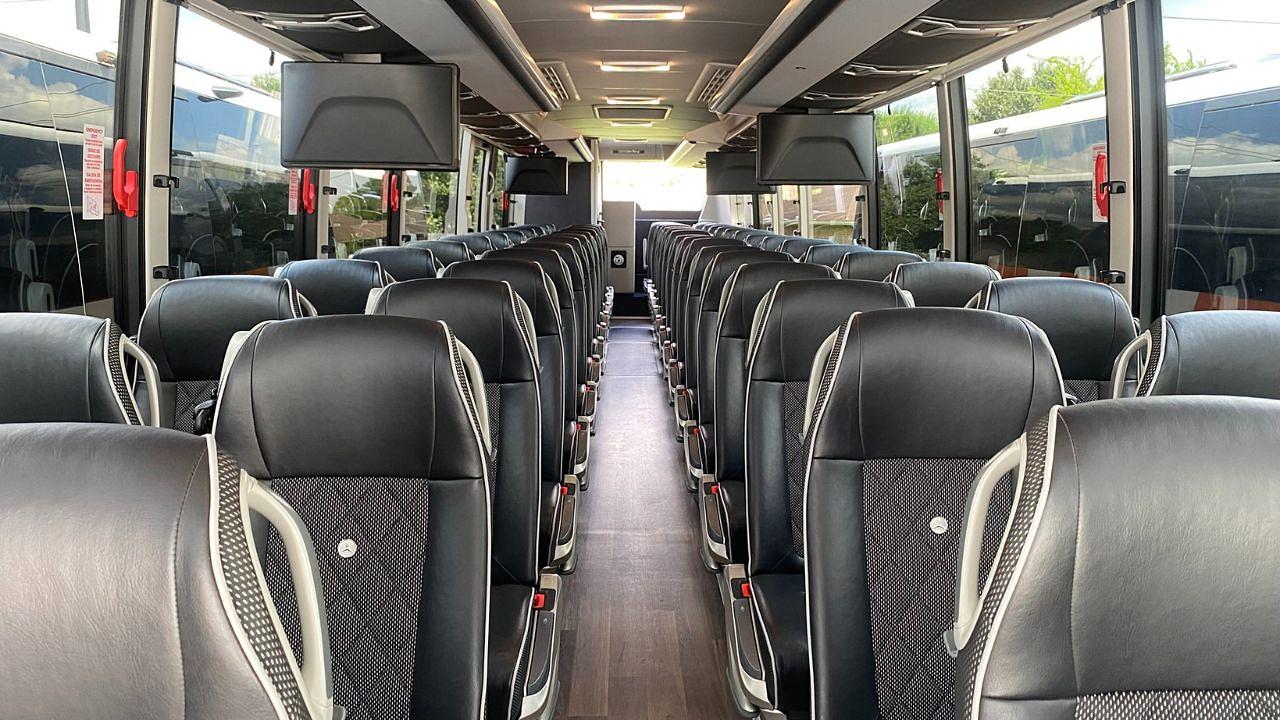
These are the real-world working configurations operators plan around, not the theoretical maximums from manufacturer spec sheets. The restroom column shows the typical seat count with a standard rear lavatory installed.
Coach Model: Prevost H3-45
Standard Capacity: 56 passengers
With Restroom: 54 to 55
Key Notes: Most popular US charter coach, strongest resale
Coach Model: MCI J4500
Standard Capacity: 56 passengers
With Restroom: 54 to 55
Key Notes: Line-run and charter workhorse
Coach Model: Van Hool CX45
Standard Capacity: 57 passengers
With Restroom: 55 to 56
Key Notes: Belgian design, slightly higher max capacity
Coach Model: TEMSA TS45
Standard Capacity: 56 to 57 passengers
With Restroom: 55 to 56
Key Notes: Growing US presence, strong amenity standard
Coach Model: TEMSA TS30
Standard Capacity: 34 passengers
With Restroom: 34 (included)
Key Notes: Mid-size, dedicated contract use only
Coach Model: MCI D45 CRT LE
Standard Capacity: 55 passengers
With Restroom: 53 to 54
Key Notes: Popular line-run, accessible configuration
The Prevost H3-45 and MCI J4500 are the dominant full-size charter platforms in the US. Both seat 55 to 56 in standard configuration with a restroom. They have the widest service networks across North America and the most liquid resale markets. For operators standardising a fleet, these two platforms are the benchmark.
TEMSA’s TS45 has grown significantly in US market presence and the Van Hool CX45 offers a slightly higher maximum capacity than most US-market competitors. The TEMSA TS30 is a 30-foot mid-size vehicle that serves dedicated smaller-group contracts, not general charter. The Bus Coach’s motorcoach inventory includes pre-owned and new units across these platforms with condition documentation on pre-owned stock.
Party Buses, Sleeper Coaches, and Specialty Types: The Full Picture
A guide that promises to cover every type needs to cover every type. Party buses and sleeper coaches both appear in the broader charter market and both operate on completely different capacity logic from standard motorcoaches.
Party Buses
Party buses seat 10 to 30 passengers but the word ‘seat’ is used loosely here. The interior of a party bus is configured around a social experience: lounge seating along the walls, standing room for dancing, bars, lighting systems, and entertainment setups. Nobody is sitting forward-facing in a row. The capacity figure tells you the occupancy limit, not the kind of travel experience being sold. Party buses are booked by the vehicle for events, celebrations, and nightlife, not by the seat for point-to-point transit. A 20-person party bus and a 20-person mini coach are completely different products at roughly similar group sizes.
Sleeper Coaches
Sleeper coaches are configured with berths rather than seats and carry 10 to 14 sleeping positions in a 45-foot body that would hold 55 passengers in a standard motorcoach configuration. They exist for situations where the group needs to travel overnight and arrive rested: touring music acts, production crews, sports teams on extended road trips. The operator market for sleeper coaches is narrow and specialised. Acquisition costs are high, the service is demanding, and the client base that can use them is small. Most charter operators never need one. But for operators serving touring productions or professional sports, a well-maintained sleeper coach at the right price is a reliable long-term contract vehicle.
What Does a Charter Bus Actually Cost Per Seat?
The cost per seat question is the one group travel planners almost always want answered and the one most capacity guides don’t touch. Here’s a rough guide based on typical US charter rates. These are estimates, not quotes. Actual rates vary considerably by region, season, mileage, operator, and trip duration. Use this table to understand the relative economics, not to set a budget.
Bus Type: Minibus / cutaway
Typical Charter Rate (per trip): $200 to $600
Capacity: 15 to 25
Rough Cost Per Seat: $12 to $30 per seat
Notes: Lowest cost, basic comfort
Bus Type: Activity school bus
Typical Charter Rate (per trip): $300 to $700
Capacity: 48 to 60
Rough Cost Per Seat: $6 to $15 per seat
Notes: Budget option, minimal comfort
Bus Type: Mini coach
Typical Charter Rate (per trip): $400 to $900
Capacity: 25 to 34
Rough Cost Per Seat: $15 to $35 per seat
Notes: Mid-range comfort
Bus Type: Full-size motorcoach
Typical Charter Rate (per trip): $800 to $2,000+
Capacity: 55 to 56
Rough Cost Per Seat: $15 to $36 per seat
Notes: Best comfort per dollar at scale
Bus Type: Luxury / VIP coach
Typical Charter Rate (per trip): $1,200 to $3,500+
Capacity: 20 to 35
Rough Cost Per Seat: $40 to $100 per seat
Notes: Premium rate justified by experience
Bus Type: Double-decker
Typical Charter Rate (per trip): $1,500 to $3,000+
Capacity: 60 to 80
Rough Cost Per Seat: $20 to $45 per seat
Notes: Specialty use, route-specific
The full-size motorcoach row deserves attention. At $15 to $36 per seat at scale, a 56-passenger coach on a full-capacity booking delivers better comfort per dollar than a school bus or minibus at comparable per-seat rates, particularly on trips over two hours. This is why groups that default to the cheapest bus option often find that the comfort gap costs them on passenger experience and repeat booking rates.
For operators, the cost-per-seat table tells a different story. A luxury VIP coach at $40 to $100 per seat generates substantially more revenue per vehicle per trip than a standard coach at $15 to $36, but requires a client base willing to pay for the premium. The seat count goes down, the rate goes up, and the math only works if the account volume justifies the reduced capacity.
Standard 56-Passenger Coach Seating Layout: Row by Row
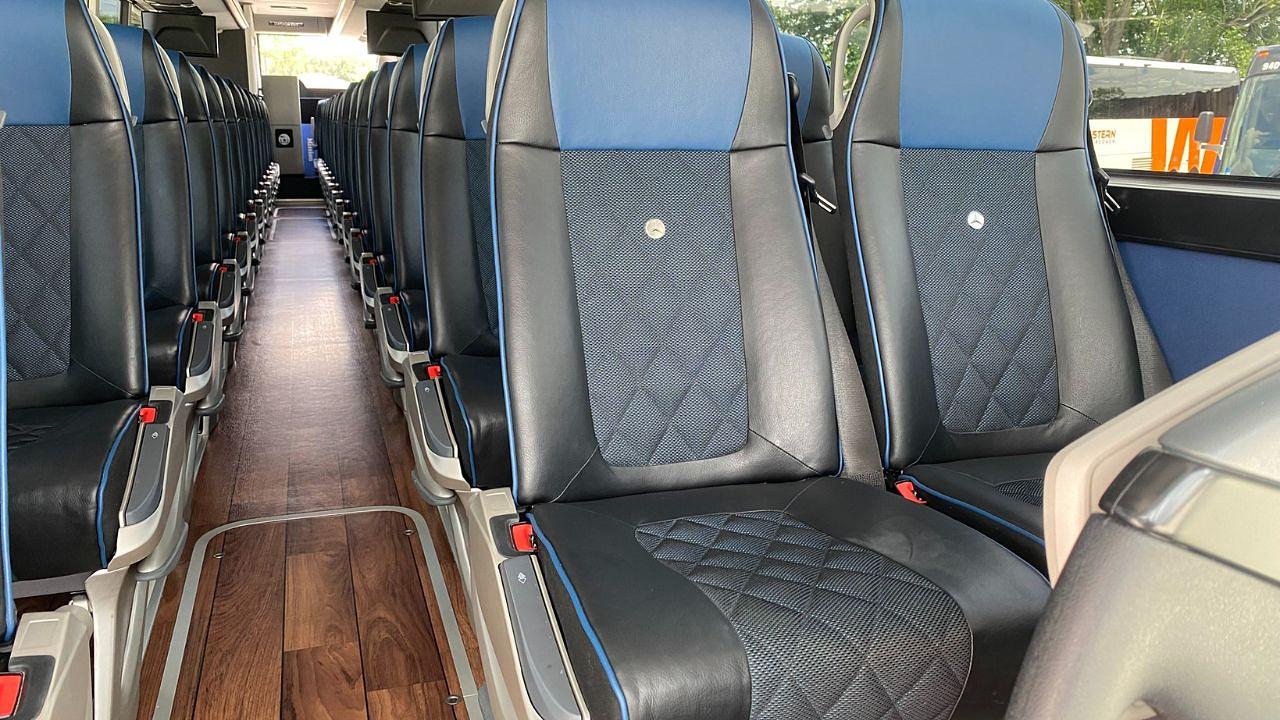
Group travel planners and operators booking coaches for events often need a reference for how seats are physically arranged. A standard full-size 56-passenger motorcoach is configured in rows of two seats on each side of a central aisle, with the driver and entrance at the front and the restroom at the rear.
Row: 1
Left Seat: 1A
Right Seat: 1B
Notes: Front row, often reserved for tour director
Row: 2
Left Seat: 2A
Right Seat: 2B
Notes: Standard row
Row: 3
Left Seat: 3A
Right Seat: 3B
Notes: Standard row
Row: 4
Left Seat: 4A
Right Seat: 4B
Notes: Standard row
Row: 5
Left Seat: 5A
Right Seat: 5B
Notes: Standard row
Row: 6
Left Seat: 6A
Right Seat: 6B
Notes: Standard row
Row: 7
Left Seat: 7A
Right Seat: 7B
Notes: Standard row
Row: 8
Left Seat: 8A
Right Seat: 8B
Notes: Standard row
Row: 9
Left Seat: 9A
Right Seat: 9B
Notes: Standard row
Row: 10
Left Seat: 10A
Right Seat: 10B
Notes: Standard row
Row: 11
Left Seat: 11A
Right Seat: 11B
Notes: Standard row
Row: 12
Left Seat: 12A
Right Seat: 12B
Notes: Standard row
Row: 13
Left Seat: 13A
Right Seat: 13B
Notes: Standard row
Row: 14
Left Seat: 14A
Right Seat: 14B
Notes: Rear section begins
Row: Rear
Left Seat: Restroom
Right Seat: Restroom
Notes: Rear lavatory module, replaces 2–4 seats
The actual row count on a 55 to 56-passenger coach is typically 14 rows of 4 seats (2 on each side) plus the front row, giving 58 to 60 theoretical seats, minus 2 to 4 for the restroom module at the rear. Some operators number seats differently and some coaches have a slightly different layout depending on manufacturer. The row-by-row structure above is the standard reference for planning group seating assignments.
For tour directors and event planners, the front-left seat of row 1 is convention for the tour guide or host position. The front-right position (1B) is typically the co-pilot or assistant position. These are conventions rather than requirements, but most group charter operators follow them.
Seating Capacity vs Legal Capacity: What Operators Need to Know
Seating capacity and legal total capacity are not the same number. Seating capacity is the count of fixed seats. Legal total capacity includes approved wheelchair positions on ADA-accessible coaches, which can add to the total passenger count the vehicle is authorised to carry in specific configurations.
Standing passengers are not permitted on highway coach services in the US regardless of vehicle configuration. The number you report to DOT, the number on your operating authority, and the number you quote to clients all need to be consistent with the actual configuration of that specific vehicle. Coaches where seats have been added or removed need updated documentation to reflect the change before operation.
• DOT documentation: must reflect actual seating configuration, not original spec sheet numbers
• Seat reconfigurations: require documentation updates before operating under the new count
• Wheelchair positions: count separately from fixed seats in ADA configurations
• No standing passengers: on highway services regardless of vehicle capacity
• Party buses: have different occupancy rules for event-only use vs point-to-point transit; verify with your carrier’s DOT authority
Choosing the Right Capacity: Operators vs Group Planners
The right capacity answer depends on which question you’re actually asking.
If you’re planning a group trip
Match the bus type to your group size, your trip length, and your budget per person. For groups of 40 or more on trips over 2 hours, a full-size motorcoach delivers the best balance of cost per seat, comfort, and amenities. For groups under 25 on short trips, a minibus or mini coach is a better fit and likely cheaper. For events and celebrations where the experience on the bus matters as much as the destination, a party bus operates on completely different logic and should be priced and evaluated accordingly.
If you’re operating a fleet
Build on the 55 to 56-passenger full-size motorcoach as your standard. It covers the broadest range of bookings, supports the highest flexibility to assist competitors during peak demand, and exits the resale market most cleanly. Add niche capacities, mini coaches, school buses for budget work, or specialty vehicles, once you have specific contracts that justify the reduced flexibility. A uniform fleet where vehicle age is the primary variable, rather than vehicle type, consistently produces lower operating costs over time. And when budget operations require lower-cost vehicles, well-priced used motorcoaches outperform school buses on passenger experience and resale value at comparable acquisition costs.
For operators: the most common expensive fleet mistake is buying non-standard capacity vehicles before having the contract to fill them. A 34-passenger mid-size coach sitting at the depot because the group came in at 37 passengers isn’t a capacity solution. It’s a capital problem. Standard coaches first.
Coach bus seating capacity sits at the intersection of two very different decisions: what to book for a group trip and what to build into a fleet. The answer to both questions starts with the same reference point, the 55 to 56-passenger US standard, and branches from there depending on what you actually need. The Bus Coach carries motorcoaches across the full capacity range, with pre-owned and new options and condition documentation on every pre-owned listing.
Browse current coach inventory at The Bus Coach.
Here’s the question worth sitting with: if your group size changed by 10 passengers either way, would your current or planned vehicle still make sense, or would you be sending the wrong bus for the wrong reasons?
FAQs
1.What is the standard coach bus seating capacity in the US?
The standard US full-size motorcoach seats 55 to 56 passengers in charter configuration with a rear restroom. Without a restroom, the count reaches 57 to 59 on some models. The 56-passenger setup is the most common and is the reference point for most operators, clients, and safety regulations.
2.Why do some coaches list 58 or 59 seats on the spec sheet but seat 55 to 56 in practice?
The restroom module at the rear of a standard motorcoach physically occupies the space of 2 to 4 seats. The spec sheet maximum reflects the seating count without a restroom installed. The working capacity with a standard rear lavatory is 55 to 56 on most full-size US coaches. Nearly every charter coach in the US market includes a restroom as standard configuration.
3.What is the seating capacity of different coach bus types?
Minibus or cutaway: 15 to 30. Mini coach: 24 to 35. Activity school bus: 48 to 72. Full-size motorcoach: 55 to 56 (US standard). Luxury or VIP coach: 20 to 40. Double-decker: 60 to 80. Party bus: 10 to 30. Sleeper coach: 10 to 14 berths.
4.How much does a charter bus cost per seat?
Rough estimates by bus type: minibus at $12 to $30 per seat, school bus at $6 to $15, mini coach at $15 to $35, full-size motorcoach at $15 to $36, luxury or VIP coach at $40 to $100. Actual rates vary significantly by region, season, trip length, and operator. The full-size motorcoach typically delivers the best comfort-per-dollar ratio at group sizes of 40 or more.
5.What is a party bus seat and how is it different from a coach?
Party buses seat 10 to 30 passengers in lounge-style seating configured for social events rather than forward-facing transit. The capacity figure is an occupancy limit, not a seating row count. Party buses are booked for celebrations and events, not point-to-point group transport. They are a completely different product from a motorcoach at similar group sizes.
6.What is a sleeper coach and how many passengers does it carry?
Sleeper coaches are configured with sleeping berths rather than seats and carry 10 to 14 sleeping positions in a body length that would seat 55 passengers as a standard motorcoach. They serve touring music acts, sports teams, and production crews on multi-night travel. They are specialty vehicles for a narrow operator market and are not suitable for day charter work.
7.What capacity is best for a small charter fleet?
The 55 to 56-passenger full-size motorcoach handles 99% of group charter requests, supports competitive pricing, and has the most liquid resale market. Non-standard capacities should be added when specific contracts justify them. Budget work that doesn’t require premium comfort is often better served by well-priced used motorcoaches than school buses, which have worse resale value in a charter fleet context.
8.How are seats numbered on a standard coach bus?
A standard 56-passenger coach has rows numbered from front to back, with seats labelled A (left) and B (right) within each row. Row 1 is at the front behind the driver. The rear section ends with the restroom module where the last 2 to 4 seats would otherwise be. Row 1A (front left) is convention for the tour director or host position.
9.Does removing seats reduce legal capacity for DOT purposes?
Yes. DOT documentation must reflect the actual seating configuration of the vehicle, not the original spec sheet number. If you add or remove seats, or install a wheelchair lift that replaces fixed seats, the vehicle documentation needs to be updated accordingly before operation. Operating under an incorrect capacity declaration is a compliance risk.